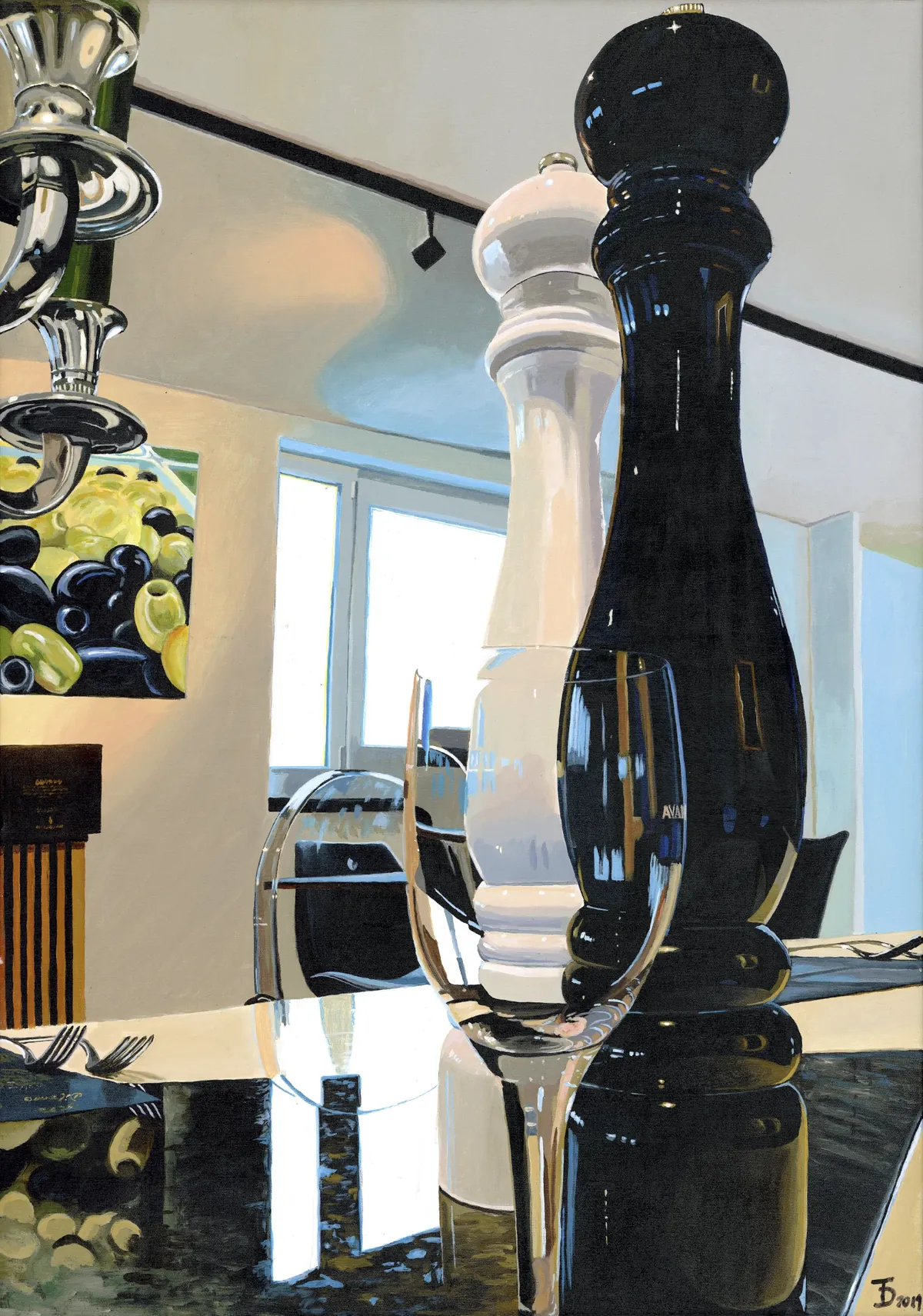
70 x 100 cm, Acrylic on canvasIn “Salt and Peppa,” Thomas Düwer arranges a still-life-like interior scene that is both homage and reflection on perception. At the center stand two oversized salt and pepper mills in black and white – iconic, almost figural. Their presence dominates the picture, but the real play begins in the reflections and overlaps: a wine glass seems to intersect with the mills, its contours continuing into the acrylic back of a Philippe Starck chair. The boundaries between object and reflection, foreground and background, function and abstraction blur. On the left wall hangs another painting – a realistically painted bowl of black and green olives. This self-reference recalls the old masters, who included their own works in their compositions. Düwer quotes himself here and at the same time anchors his painting in an art-historical tradition of meta-reflection. The olive motif not only echoes the round forms of the mills but also contributes to the culinary context – a space of pleasure, design and staging. The lighting is precisely set, cool and modern. Highlights on glass and acrylic surfaces, reflections on the polished tabletop, the transparency of the material – all of this testifies to Düwer’s technical virtuosity, but also to a calculated play with viewing habits. What is real and what is reflection, what is foreground and what is mirror image, remains deliberately ambiguous. “Salt and Peppa” is also a commentary on perception itself: a tableau in which objects become signs and painting asserts itself as a medium of visual intelligence.