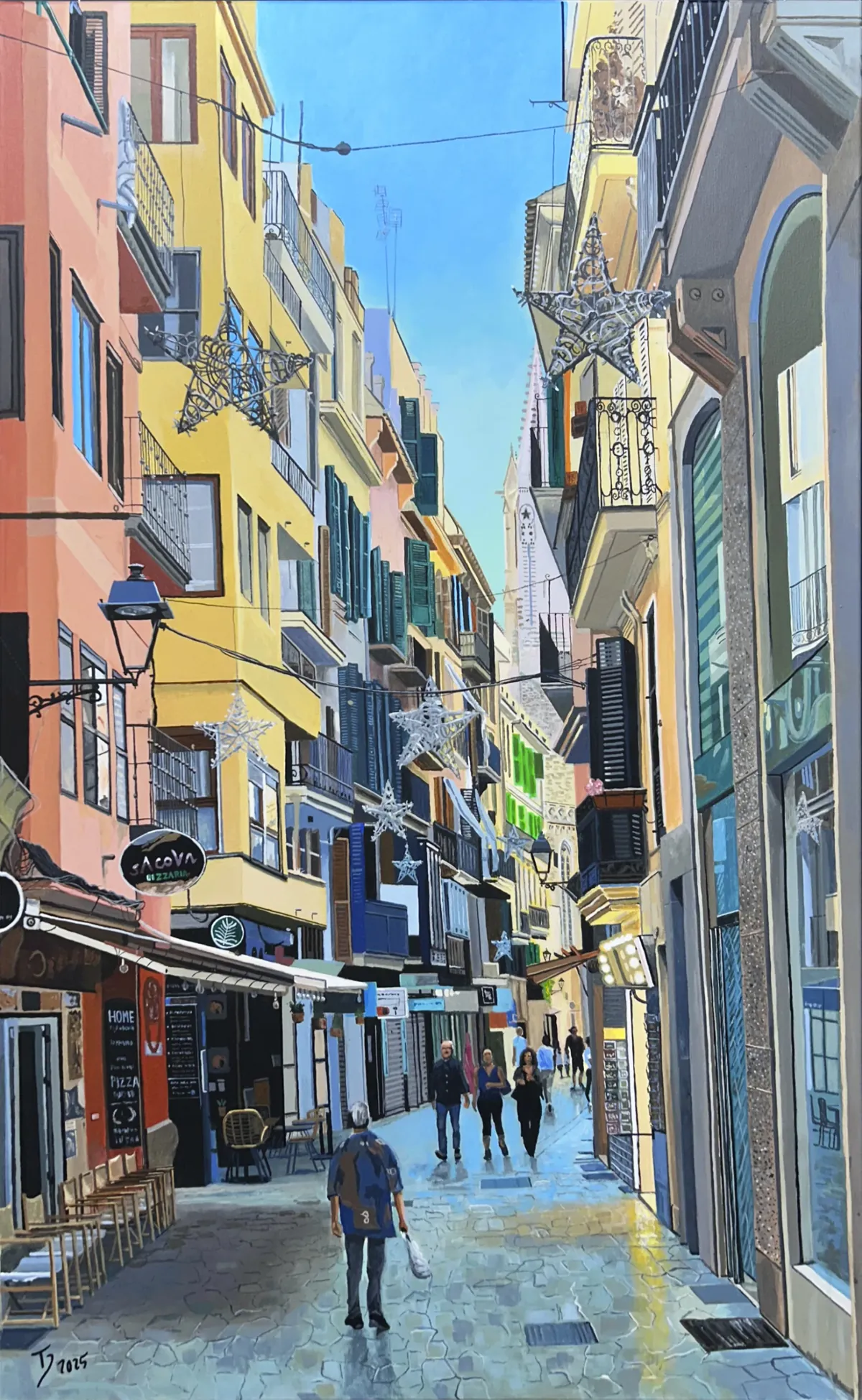
80 x 130 cm, Mixed mediaIn “Palma de Mallorca,” Thomas Düwer presents a Mediterranean alley in portrait format, not as a picturesque holiday scene, but as a finely structured architecture of color fields. At first glance, the setting appears familiar: a narrow street, colorful facades, open shutters, small shops, and above them a garland of silver stars. Yet beneath this seemingly touristic surface lies a subtle painterly order that translates the street space into rhythmic modules. The facades become a stage. Each layer of color, each window opening, each shadow is placed with precision. The rows of buildings overlap like stage sets, as if the urban space were a constructed façade. What is real and what is symbolic remains deliberately unresolved. The color scheme follows a clear logic: warm earth tones on the left, cool blues and reflections on the right. Shutters in green, black, or petrol introduce calculated contrasts within this order. The star decorations, seemingly incidental, function here as a structuring ornament that spans the alley like a delicate bracket of light and line. Equally striking is the approach to depth. The view extends into the distance, all the way to the cathedral La Seu, yet the visual logic remains planar. The composition resembles a mural more than a traditional street scene. The figures at the bottom edge of the painting do not appear as individuals but rather as part of a choreography. They introduce scale, not narrative. Palma de Mallorca is, in this sense, not a scene but a construction. Düwer maps the urban space, breaking it down into elements, rhythms, and textures. What seems to be a lively alley becomes a grid of color, line, and surface, and a tribute to a Mediterranean light that illuminates and shapes.